Climate change in Tenerife, from the harbour in Santa Cruz to Mount Teide
Where is Tenerife warming fastest? A walk from the old Maya building to the waterfront sets the scene for a surprising comparison with the highlands of Las Cañadas del Teide.
From AC Hotel Tenerife by Marriott, in the old Maya building on Calle Candelaria, it is a short walk to the lake in Plaza de España. Down by the harbour, a light breeze might be all you need to stay comfortable. A few hours later, up in Las Cañadas del Teide, you may be reaching for a jacket. These cool highlands have recorded the fastest warming of the areas studied.
What the night-time readings tell us
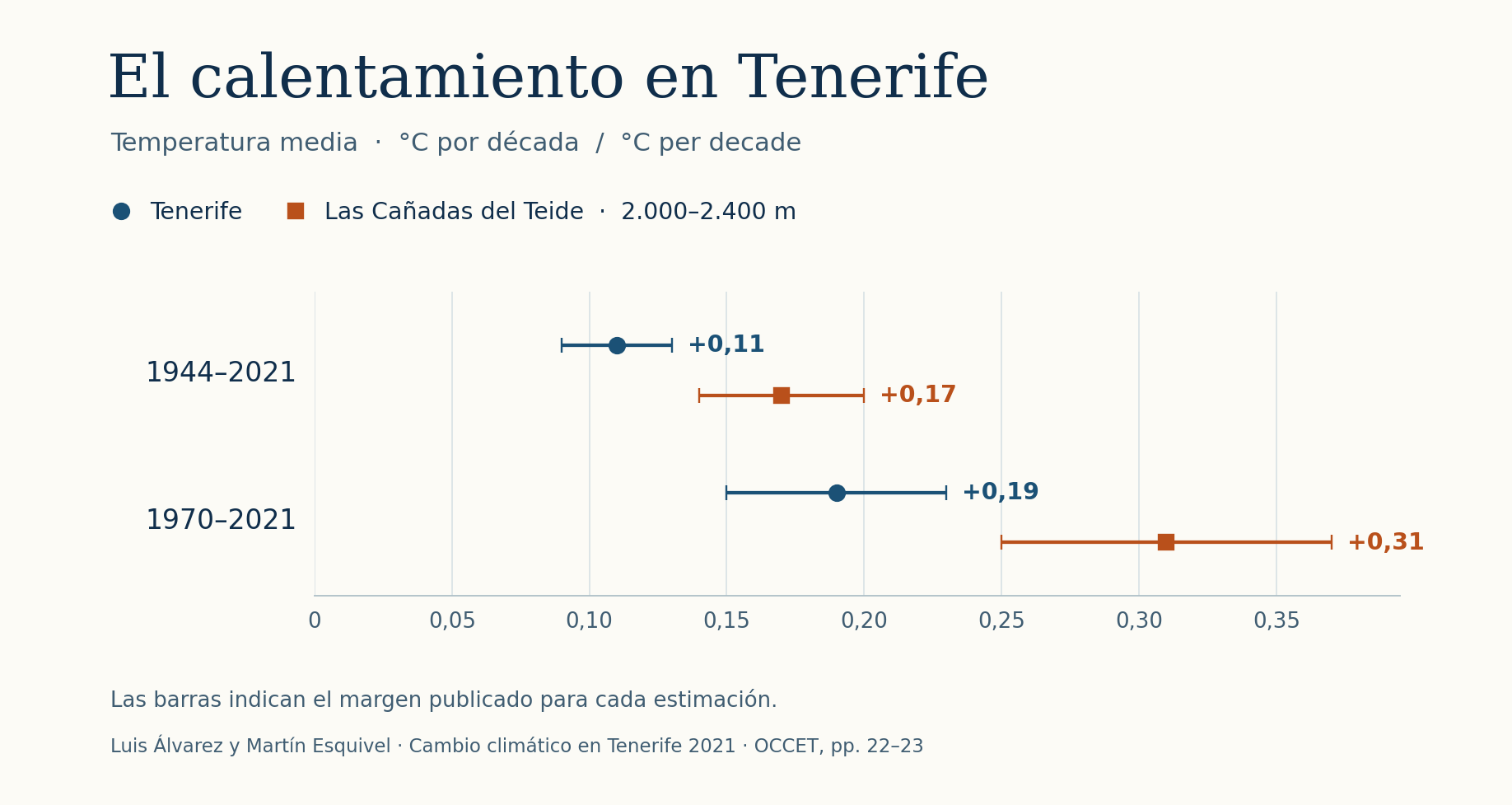
The report “Cambio climático en Tenerife 2021” estimates that the island’s average temperature rose by about 0.85 °C between 1944 and 2021. Daily lows, usually recorded towards dawn, rose by 0.17 °C per decade. One way to picture what that means for residents is to think of an open window late on a summer night and how much cool air it lets in.
The chart compares Tenerife as a whole with Las Cañadas, at an elevation of 2,000 to 2,400 metres. Between 1970 and 2021, average temperatures there rose by 0.31 °C per decade. The island-wide rate over the same years was 0.19 °C per decade. A chilly morning on Teide fits that long-term pattern just fine. When planning a trip up the mountain, look up the forecast for the highlands as well as the one for Santa Cruz.
Where the rain goes
Some of Tenerife’s rain seeps through volcanic ground and replenishes underground aquifers. Wells and water tunnels cut into the mountains tap those reserves. The island’s rainfall records up to 2023 suggest a decline, although the trend depends partly on the period chosen. The 1950s were particularly wet. A shorter shower after the beach is a small way to look after water whose journey began long before it reached the tap.
A morning walk from Calle Candelaria
Start early at the Mercado de Nuestra Señora de África. On the way back, beside the Barranco de Santos, the Museum of Nature and Archaeology (MUNA) is a good place to get to know the rocks and species you will encounter around the island. Save the museum for the warmest hours and enjoy Plaza de España later in the afternoon. For an outing to La Laguna the next day, tram line 1 connects the two cities.
The chart uses figures from Tatiana Luis Álvarez and José Luis Martín Esquivel’s report, available from Tenerife’s Climate Change and Energy Observatory (occet.es). The same site has the island’s rainfall series up to 2023.